
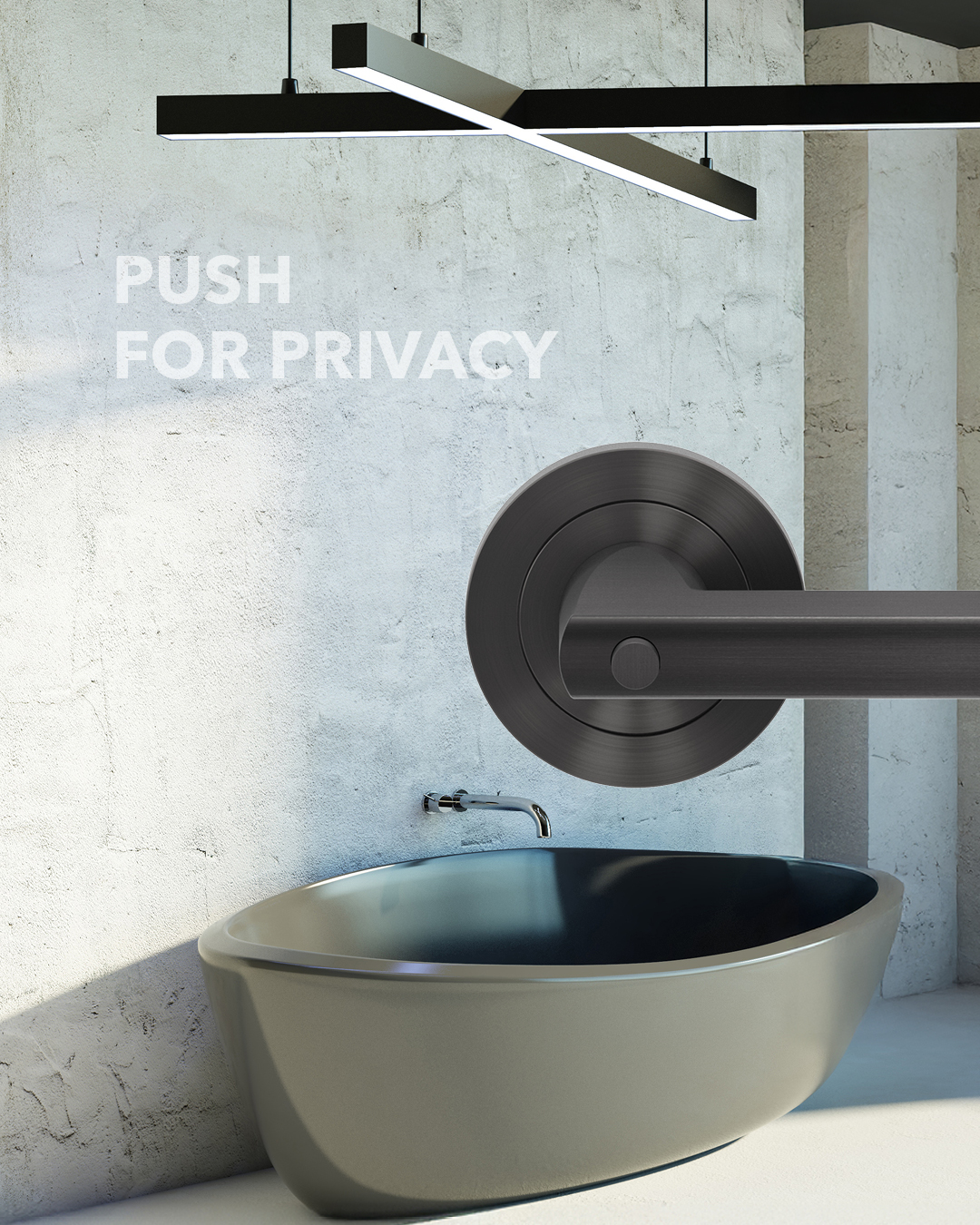
The Detail Every Luxury Bathroom Eventually Confronts
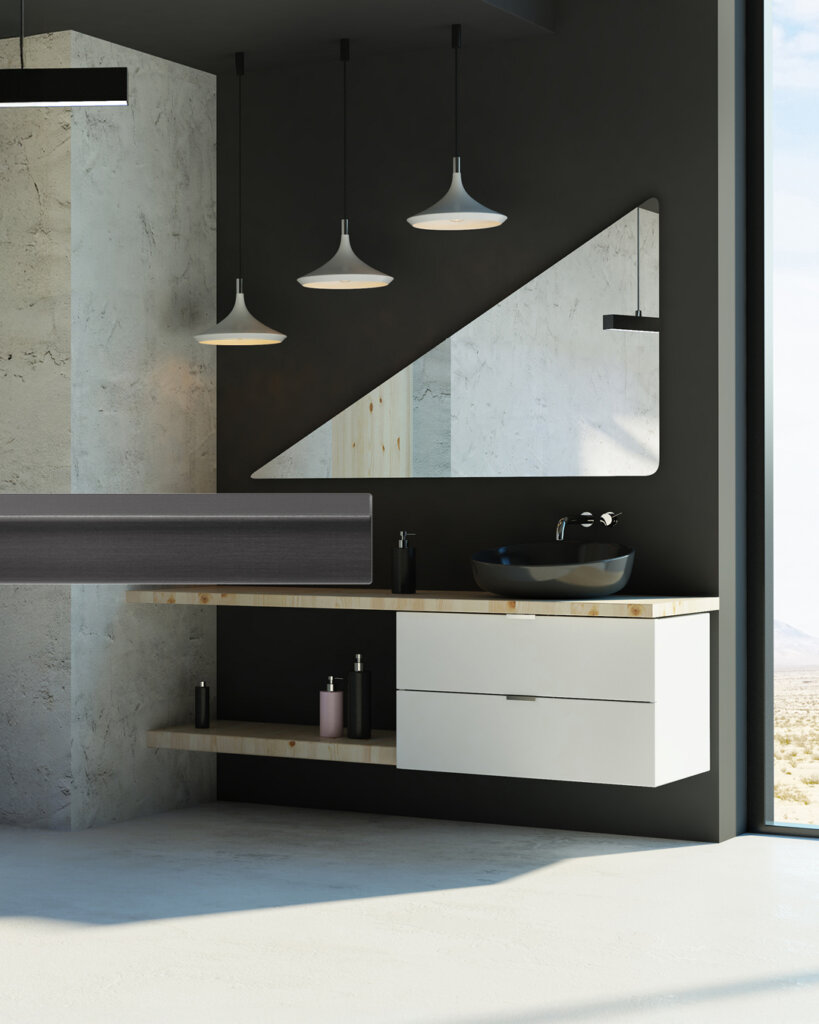
You have spent months on the renovation. The marble was flown in. The vanity was custom-made. The tap was specified by your interior designer down to the finish code. Every surface in the master bathroom has been considered, debated, and decided.
Then someone installs the door hardware.
On the outside face: a clean, modern lever handle. Precisely the one you chose. The finish matches everything else in the room.
On the inside face: a separate thumb-turn mechanism. A different profile. A different height. Mounted on its own rose, in the centre of the door, demanding attention it has no business demanding.
Nobody specified it. Nobody chose it. It simply appeared — because every bathroom door lock in the conventional specification includes one.
Why the Thumb Turn Exists
The thumb turn is a separate hardware component that engages the privacy function of a bathroom lock. You twist it to lock from the inside, and twist it back to unlock. It has been the standard solution for residential bathroom privacy for decades — and for good reason. It works. It is simple. It requires no explanation.
The problem is not functional. The problem is visual.
A standard bathroom lock requires two separate hardware components on the inside face of the door: the lever handle and the thumb turn. These are specified, manufactured, and installed as independent pieces. Even when they come from the same range, they occupy different positions, carry different profiles, and create two separate focal points on a surface that — in a considered interior — should have none.
“In a room where every surface has been resolved, the door hardware is the one place where most specifications quietly accept a compromise.”
In most renovations, this compromise goes unnoticed until the project is complete. By then, the handles are on, the locks are fitted, and the decision has been made by default. The thumb turn stays.
What Changes When You Specify Differently
The KD Basic door handle by Kärcher Design eliminates the thumb turn entirely.
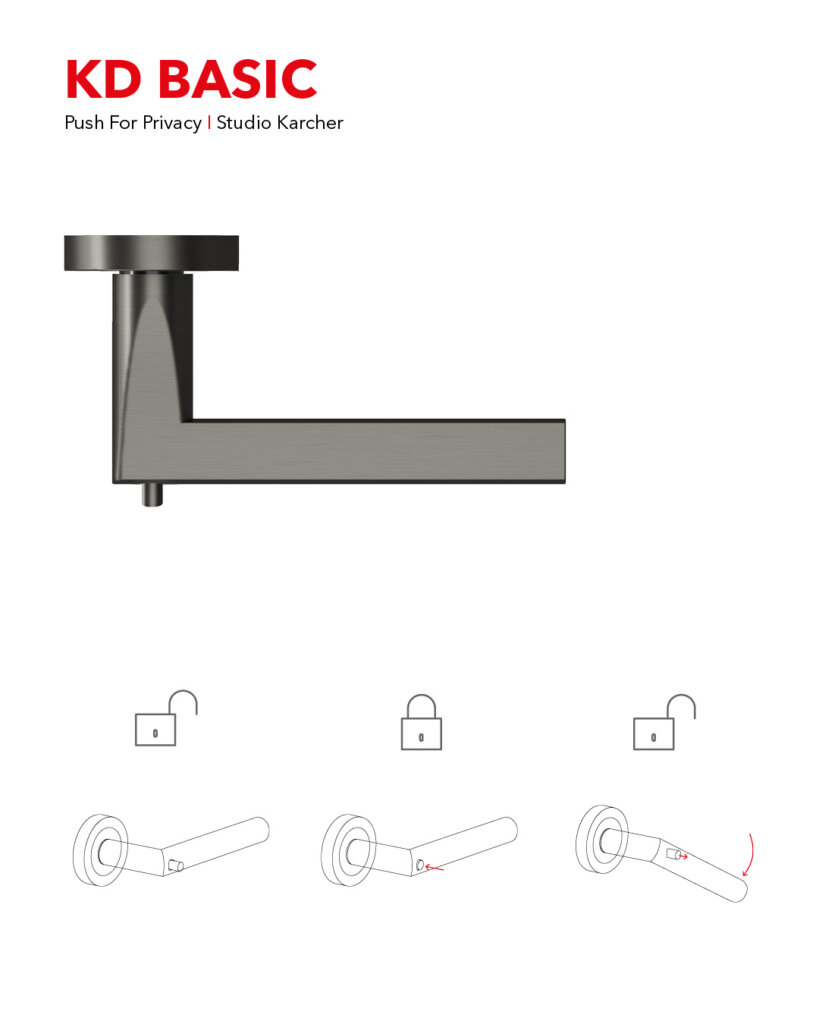
It does this by integrating the privacy function directly into the lever handle body. A small Privacy-Pin sits within the handle itself. Push it — the door locks from the inside. Push again — it releases. One gesture. One component. The inside face of the bathroom door shows exactly one piece of hardware: the handle.
There is nothing else. No separate rose for the privacy function. No thumb turn. No second component to specify, source, or match. The inside face of the door is identical to the outside.
This matters in any renovation where the door hardware is part of the design language rather than an afterthought. It matters particularly in master bathrooms, en-suite bathrooms, and hotel-grade residential projects where the standard specification has always quietly accepted the compromise the thumb turn represents.
How It Works in Practice
The Privacy-Pin in the KD Basic is designed for one-handed operation. You do not need to locate a separate component, change your grip, or use two hands. The locking gesture is the same motion as pressing a button — small, immediate, and intuitive from the first use.
The mechanism is compatible with any standard mortise lock. There is no requirement for a special lockset, a modified door preparation, or a different installation process. KD Basic replaces a standard lever handle directly. The door preparation is unchanged.
It is available in Cosmos Black — an electrostatic powder coating applied to stainless steel, producing a soft, matte finish — and Satin Stainless Steel.
Who Should Specify KD Basic
KD Basic is relevant for any project where the bathroom door hardware specification currently relies on a conventional thumb-turn privacy lock — which is to say, almost every project.
For architects and interior designers, it resolves a specification problem that has previously had no elegant solution. The inside face of the bathroom door can now be designed to the same standard as everything else in the room.
For property developers working at the luxury residential end of the market, KD Basic is a specification upgrade that is visible, tactile, and immediately understood by buyers during a show unit walkthrough. It is the kind of detail that answers the question before it is asked.
For homeowners renovating a master bathroom, it is the answer to the problem you noticed but could not name — the reason the inside of the bathroom door never quite matched the rest of the room.
Available in Malaysia Through KeysonAI
KD Basic is part of the Kärcher Design range, manufactured in Germany and certified to DIN EN 1906. KeysonAI is Malaysia’s sole authorised Kärcher Design distributor, with 12 years of supply and specification experience across residential and commercial projects in Klang and Kuala Lumpur.
Physical samples are available for viewing at our Bdr Bkt Raja showroom by appointment. Specification sheets and DIN documentation are available on request from our trade team.
Enquire about KD Basic
Specification sheets, trade pricing, and sample viewing available at our Bdr Bkt Raja showroom. Our team responds within one business day.