
Blog
There is a photograph that sits at the centre of everything Kärcher Design makes.
White-gloved hands. A black knurled handle body meeting a polished brass collar. Other handles visible in soft focus behind, resting on a dark workshop surface. A storage grid with red-lit slots in the background.
It looks like watchmaking. Like haute horlogerie. Like a room where the standard of care applied to every object is not negotiable.
This is not a staged image. This is how every Studio Series handle begins.
Why Manufacturing Process Matters in Door Hardware
Most door handles sold in Malaysia are sourced from one of two places: a Chinese factory producing zinc alloy castings to a price point, or a European brand whose manufacturing story is told in marketing copy rather than documented in certification.
The difference matters more than it is usually acknowledged — and it matters most in Malaysia, where tropical humidity, daily temperature cycling between outdoor heat and air-conditioned interiors, and high-frequency use across the life of a building combine to stress door hardware in ways that temperate-climate manufacturing standards do not fully anticipate.
A zinc alloy handle plated in chrome or brushed brass will hold its finish for two to three years in a Malaysian interior before the plating begins to lift at stress points — around the rose fixings, at the collar, along the edge of the knurl. A handle machined from solid stainless steel with a PVD finish, assembled to the tolerances that Kärcher Design specifies, will not.
The Studio Series is the latter. Understanding why requires looking at what happens before the handle reaches you.
The Material Foundation — Stainless Steel and Brass, Not Zinc
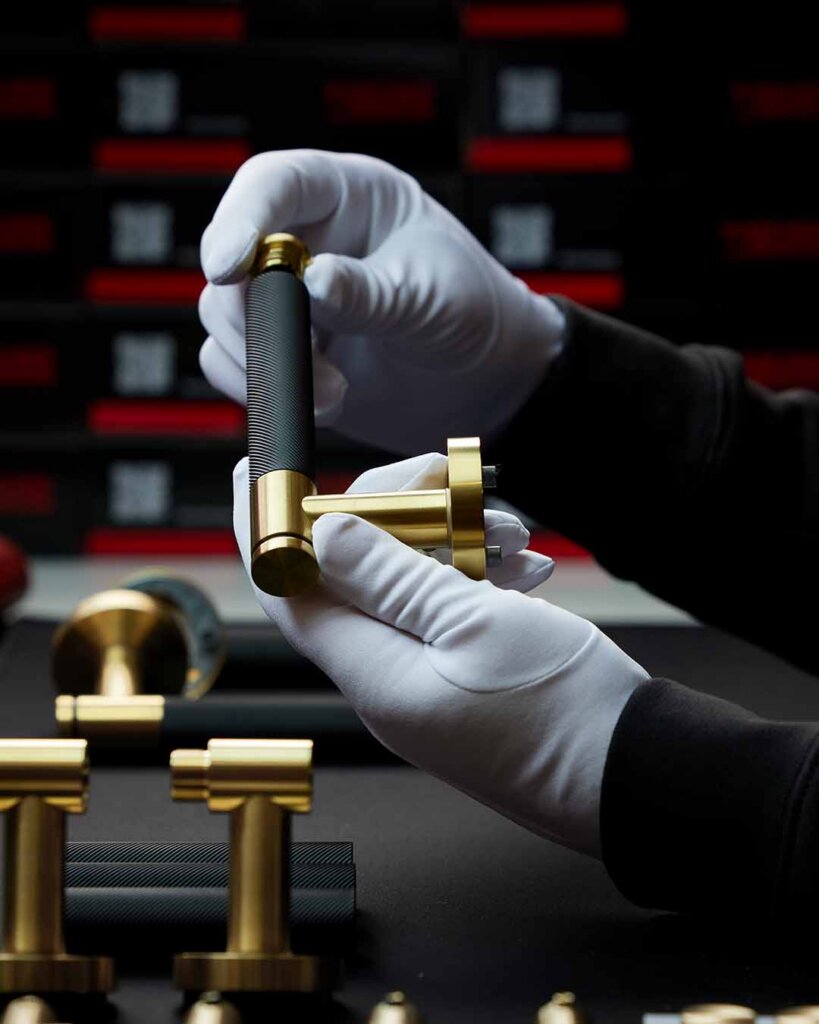
The Studio Series handle body is machined from stainless steel — not cast from zinc alloy, not formed from aluminium. Stainless steel is harder, denser, and substantially more resistant to the galvanic corrosion that occurs when dissimilar metals meet in humid conditions. In a Malaysian context, where air-conditioning creates condensation on surfaces and coastal air carries elevated salt content in cities like Penang and Port Dickson, the material substrate of a door handle is not a secondary consideration.
The collar and end cap — the gold elements visible in the Fertigung image — are machined from solid brass. Brass is not chosen for its appearance alone. It is chosen because it machines to tighter tolerances than zinc, holds a surface finish longer, and develops a patina that improves with age rather than degrading to a powdery residue.
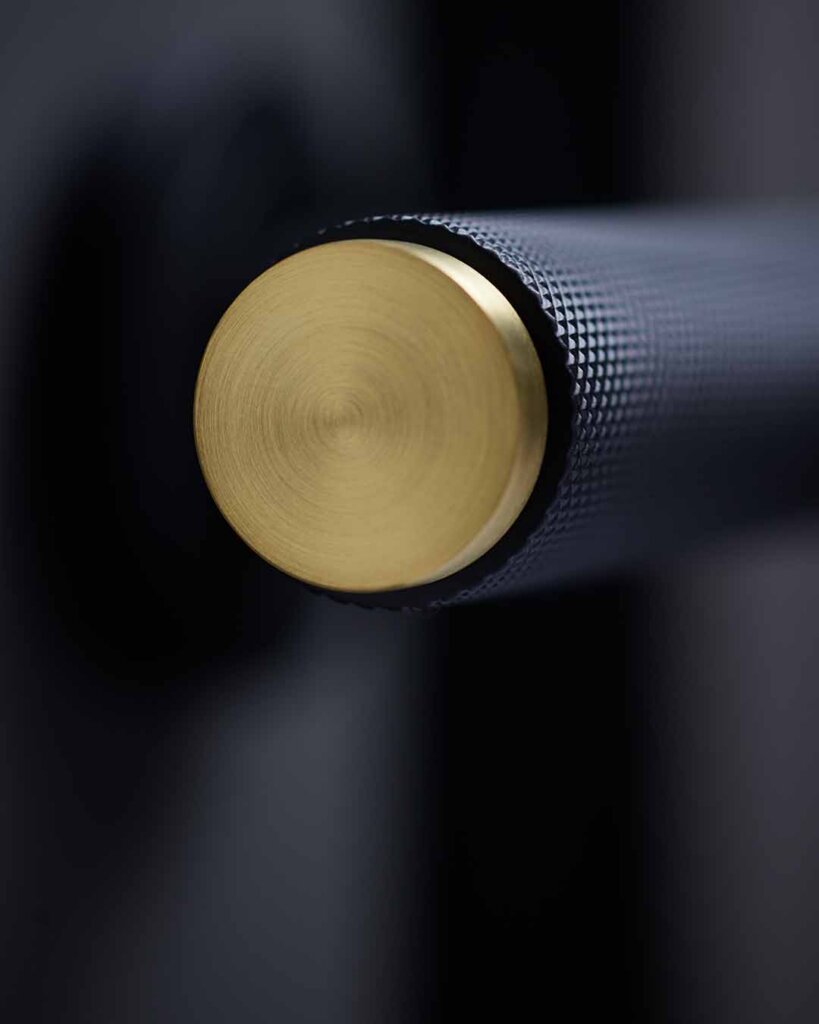
The knurling — the diamond or linear pattern cut into the handle grip — is machined directly into the stainless steel surface. It is not applied. It is not printed. It is the surface itself, shaped by a cutting tool running at a controlled feed rate and depth. This is why a Diamond Touch handle feels different from a decoratively textured handle: the geometry is precise, consistent across the full barrel length, and unchanged by temperature, humidity, or years of daily contact.
The Tolerances — What 0.01mm Means in Practice
The end cap of a Studio Series handle is turned on a lathe. The concentric marks visible on the brass face — the fine rings running from the centre outward — are the record of the tool path. They are not a decorative pattern. They are evidence of a specific machining process, applied to a specific material, at a specific tolerance.
Kärcher Design manufactures to tolerances measured in hundredths of a millimetre. In practical terms this means two things.
First, every Studio Series handle fits its rose, collar, and fixings without play. There is no rattle, no lateral movement, no loosening under repeated use. The handle sits in the hand with the same solidity on the ten-thousandth use as on the first.
Second, every handle in a configured order — whether two sets for a single apartment or forty sets for a gated community development — is consistent. The gap between the collar and the handle body is the same on every unit. The feel of the knurl is identical across the batch. This consistency is what makes the Studio Series specifiable for developer-scale projects: the sample matches the delivery.
For architects writing ironmongery schedules, this is the point at which a sample set becomes meaningful. A Studio Series sample is not a representative approximation. It is an exact specimen of what will be installed.
The Assembly — White Gloves as Standard, Not Theatre
Specification is a responsibility. When an architect or interior designer writes a hardware schedule, every item on it carries their name alongside the client’s project. The credibility of the hardware reflects on the credibility of the specification.
Kärcher Design earns that credibility on several grounds.
The Studio Series is ISO 9001 certified and carries the BS EN 1303 rating — the British and European standard for cylinder security and mechanical durability. For architects writing specifications for luxury residential projects, high-end condominiums, or gated community developments, these certifications are the documentation required to substantiate a material choice.
Every Studio Series handle is assembled by hand. The image above shows what this means in practice: white gloves, deliberate assembly, a precision inspection before any handle leaves the Kärcher Design factory in Germany. This is not a marketing claim. It is a manufacturing standard — visible in the tolerance of every machined surface, and in the consistency of every handle produced.
KeysonAI has supplied ironmongery to more than 30 completed developer projects in Malaysia, including projects with Sunway, YTL, and SP Setia. Our trade team understands the scheduling process, the lead times, and the documentation requirements of luxury residential specification in this market. Specification sheets, BS EN 1303 certification documentation, and sample sets are available on request.
What makes the Fertigung image significant is not the white gloves themselves. It is what the white gloves signal about the assembly environment.
White gloves in a manufacturing context indicate a clean-room standard of handling — a requirement that the surface of each component be protected from fingerprints, oils, and contamination before assembly. In door hardware manufacturing, this standard is rare. It is common in watchmaking. It is common in optical instrument production. It is not common in ironmongery.
Kärcher Design applies it as a standard, not as a quality control step. Every handle is assembled this way. Every handle is inspected before it leaves the factory. The inspection is not a sampling exercise — a percentage of units checked against a tolerance. It is a unit-level check. Every handle.
The result is that the defect rate in Studio Series production is close to zero. And the handles that reach Malaysia through KeysonAI have passed not only Kärcher Design’s internal standards but the certification requirements of two independent bodies.
The Certifications — ISO 9001 and BS EN 1303
ISO 9001 is an international quality management standard covering the systems, processes, and documentation controls that govern how a product is made. ISO 9001 certification is not a product test — it is a process audit. It means that Kärcher Design’s manufacturing operation has been independently assessed and verified to maintain consistent quality standards across production. For architects and developers specifying hardware for a project, ISO 9001 is the documentation that substantiates the manufacturing claim.
BS EN 1303 is the British and European standard for cylinder and lever hardware durability. It covers mechanical endurance — specifically, the number of operating cycles a door handle must complete without failure or measurable degradation. The Studio Series is rated to the standard required for high-frequency residential use — a door opened and closed at the rate typical of a family home or luxury condominium corridor will not require hardware replacement within the design life of the building.
For Malaysian developers specifying hardware at scale — forty units in a gated community, or a hundred sets across a condominium block — the BS EN 1303 rating is the specification that protects the developer’s liability and the purchaser’s investment.
Performance in Malaysia’s Climate — What to Expect From Each Finish
This is the section that does not exist in Kärcher Design’s global documentation, because it is specific to this market.
Cosmos Black (83) — PVD coating on stainless steel. PVD (Physical Vapour Deposition) is the most durable surface treatment available for door hardware. A PVD coating is not plating — it is a molecular-level bond between the coating material and the substrate. In Malaysian conditions, Cosmos Black will not lift, peel, or discolour in air-conditioned interiors over the life of a building. It is the most maintenance-free finish in the Studio Series range and the most suitable for high-frequency use environments such as entrance doors, bedroom doors, and bathroom doors in luxury residential projects.
Satin Brass (88) — living finish on machined brass. Satin Brass is the only finish in the Studio Series that changes with time and use — deliberately. The brass develops a deeper, slightly warmer patina at points of regular contact. In Malaysian conditions, Satin Brass performs best in fully air-conditioned interiors away from direct humidity exposure. For exterior-facing doors, covered walkways, or wet areas such as bathrooms with poor ventilation, Satin Brass is not the recommended choice. For a master bedroom entrance, a study door, or a living room pivot — spaces where the handle is touched with clean, dry hands in a controlled environment — Satin Brass is the material that improves with every year of use.
Satin Stainless Steel (71) — brushed finish on stainless steel. The most corrosion-resistant finish in the range and the most suitable for exterior-adjacent applications. For a covered car porch entrance, a side gate to a garden, or a balcony door in a high-rise coastal property, Satin Stainless Steel is the specification that holds its appearance without maintenance. It does not patina. It does not change. It is the same handle in twenty years as it is on the day of installation.
How to Specify the Studio Series for Your Project
KeysonAI supplies the Studio Series to architects, interior designers, and property developers across Malaysia with full specification support. Our trade team can provide:
- Physical sample sets for client presentations and material board sign-off
- Specification sheets with model codes, surface names, and finish references
- BS EN 1303 and ISO 9001 certification documentation
- Lead time information for your project schedule
- Guidance on finish selection for specific installation environments in Malaysia
The Studio Series is available exclusively in Malaysia through KeysonAI — sole authorised Kärcher Design distributor.
To request a sample set or specification documentation, contact our trade team at keyson.com.my/kd-studio-series-enquiry. To explore the full Studio Select configuration range, visit keyson.com.my/studio-select.